
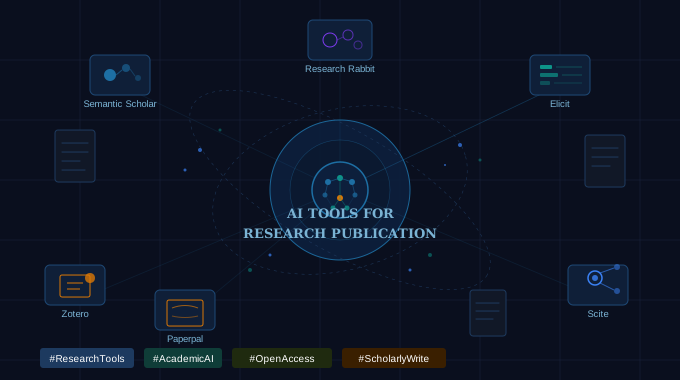
Let’s be honest — the research publication process is exhausting. You spend months, sometimes years, collecting data, running analysis, and drafting your findings. Then comes the part nobody really talks about: the grind of getting it published. Literature searches, citation management, manuscript editing, finding the right journal… it adds up fast.
The good news? AI tools have quietly gotten very good at helping with exactly this. Not replacing your thinking — but handling enough of the busy work that you can focus on what actually matters: the research itself.
Here are some of the most useful ones worth knowing about.
1. Semantic Scholar — Smarter Literature Search
If you’ve been relying solely on Google Scholar, Semantic Scholar is worth a serious look. It’s free, built by the Allen Institute for AI, and does something Google Scholar doesn’t do particularly well — it understands context.
Instead of just matching keywords, it surfaces papers based on semantic meaning. So if you search for a concept rather than an exact phrase, you’ll still find relevant work. It also highlights highly cited papers, flags influential references within a paper, and lets you set up alerts for new publications in your area. For anyone trying to stay current without drowning in journal alerts, it’s genuinely useful.
2. Elicit — Your AI Research Assistant
Elicit is designed specifically for researchers. You type in a research question — a real one, not just keywords — and it pulls relevant papers and tries to summarize what each one says about your question.
What makes it stand out is the way it organizes results. You can extract specific data points across multiple papers (think: study design, sample size, outcomes) into a table format. For literature reviews, that alone saves a significant amount of time. It’s not perfect, and you should always verify what it surfaces, but as a first-pass tool for scoping a topic, it’s hard to beat.
3. Zotero + AI Integrations — Reference Management, Upgraded
Zotero has been around for years and remains one of the best free reference managers out there. What’s changed recently is how well it plays with AI tools. Several plugins and companion tools now let you summarize papers directly within your library, extract key points, and even help generate annotated bibliographies.
If you’re not already using Zotero, the learning curve is minimal and the payoff — especially for larger projects — is substantial.
4. Paperpal / Writefull — Academic Writing Support
These two tools sit in a similar space: AI-powered editing built specifically for academic writing. They’re different from general grammar checkers because they’re trained on academic text. They understand field-specific phrasing, flag issues with sentence structure that would confuse peer reviewers, and in Writefull’s case, can even suggest language based on how similar ideas are phrased in published literature.
Neither one writes your paper for you, and that’s actually the point. They help you say what you mean more clearly — which, if you’ve ever had a manuscript come back with reviewer comments about clarity, you know is half the battle.
5. Scite — Understanding How Papers Are Actually Cited
This one is underrated. Scite shows you not just how many times a paper has been cited, but how — whether other papers support, contradict, or simply mention it. That’s a meaningful distinction when you’re building an argument on prior work.
If you’re citing a foundational study in your manuscript, it’s worth knowing whether recent literature has challenged it. Scite makes that visible in a way standard citation tools don’t.
6. Research Rabbit — Mapping the Literature
Research Rabbit is free and takes a visual approach to literature discovery. You drop in a paper (or a handful of papers) and it generates a map of related work — what those papers cite, what cites them, and how they connect to each other.
It’s particularly helpful early in a project when you’re trying to understand the shape of a field, or late in the process when you want to make sure you haven’t missed something obvious. Think of it as a way to explore the neighborhood around your topic rather than just searching for specific addresses.
A Few Things Worth Keeping in Mind
These tools are genuinely helpful, but they work best when you treat them as assistants rather than authorities. Always verify citations directly. Double-check any summaries against the source material. And when it comes to writing tools, make sure whatever you submit reflects your own voice and analysis — not just cleaned-up AI output.
Most journals are also updating their policies on AI use in manuscript preparation, so it’s worth checking the guidelines for wherever you’re submitting.
Thanks for visiting us here
Jahid Hasan
Business Analytics Graduate
Wright State University